Tuesday, 1 November 2016

Notes & quotes

Notes & quotes 

Why print remains dominant
“It’s the passion and beliefs and ruthless investigative journalism of papers like the Mail, the Times and the Guardian that will decide on which battlegrounds the campaign is fought, and therefore play a key role in deciding who will win,”
This quote from journalist Ed Amory expresses his opinion of why print Is still a dominant medium for things like political campaigns and votes/elections.
“This technological tsunami has been mirrored by a collapse in trust in traditional media. In the UK, the former editor of the News of the World went to jail for presiding over a culture of phone hacking, and the Leveson inquiry that followed that hacking has precipitated an ongoing row over the regulation of UK newspapers, exposing the once mighty British press to increasing legal and political scrutiny,”


Decisions …
“But with fewer people buying a daily print newspaper, does an endorsement from the Sun, or any other title, really woo voters?”
How influential are the newspaper front pages? Arguably by themselves not so much but when their front pages are posted on social media and featured on national and local tv news channels. 
"In the case of the EU referendum, I think a lot of its readers are probably already decided."
I disagree with this statement as the uk was very divided on the issue in the build up to the referendum making the newspapers job even more important. 
TNS poll showed that on 23rd may one month before the referendum 16% of people were still undecided.
‘The Sun, which had waged a vitriolic campaign against his Labour rival Neil Kinnock, claimed the glory. When the paper switched sides and backed Labour's Tony Blair in 1997, it was again seen as a key moment.’

‘Tom Felle, a lecturer in journalism at City University, believes the Sun may historically have been good at reading the mood of the country and backing a winner - but he questions whether it ever had the power to sway opinion.’

‘In fact, it's as likely that the Sun echoes its readers as influences them, professor of politics at the University of Strathclyde John Curtice says’


List of uk newspapers and what side of political spectrum they are on.


Rupert Murdoch
“I once asked Rupert Murdoch why he was so opposed to the European Union. 'That’s easy,' he replied. 'When I go into Downing Street they do what I say; when I go to Brussels they take no notice,” 
Owner of the sun having this kind of opinion 


‘But today (16 June), front page stories in half the national newspaper market favoured Leave, with no front-page stories clearly favouring Remain.’
A week before the referendum and newspapers in favour of Brexit with remain campaign failing to be promoting itself.


The Sun calls the referendum result a "momentous turning point in our history".
An article summarising each papers opinion on the referendum decision


‘A recent Oxford university study found that of 928 articles taken from the first two months of the referendum campaign, 45% supported Brexit while only 27% backed remaining in the EU, leaving 19% undecided and 9% concentrating on other stories.’

Already at this stage and newspapers are already choosing which side to support and beginning to sway public opinion.

‘The report said "established news brands continue to resonate most with readers everywhere".’

This is suggesting that newspapers are still dominant in influencing public opinion.

‘There's also the view that if someone is constantly exposed to such coverage, then it is almost certain that one will be pushed in one direction or another. Although some claim that with newspapers in particular, people are already choosing to read titles based on their established political views.’

Pretty self explanatory.

‘there are over 18 million daily newsbrand readers in the UK and 82% of people believe that newspapers have 'power and influence' over their readers.’

‘As Ian Whittaker, head of European media research at Liberum, said: "The EU Referendum should be positive for newspapers as businesses. In the short-term, it will have helped to boost circulation revenues given the huge public demand for in-depth news and analysis of the Brexit vote and its consequences; and in the medium to long-term, it will be taken as a demonstration of how much influence newspapers still have, which is a persuasive argument to use with advertisers.’
Why print remains dominant


“It’s the passion and beliefs and ruthless investigative journalism of papers like the Mail, the Times and the Guardian that will decide on which battlegrounds the campaign is fought, and therefore play a key role in deciding who will win,”
This quote from journalist Ed Amory expresses his opinion of why print Is still a dominant medium for things like political campaigns and votes/elections.


“But with fewer people buying a daily print newspaper, does an endorsement from the Sun, or any other title, really woo voters?”
How influential are the newspaper front pages? Arguably by themselves not so much but when their front pages are posted on social media and featured on national and local tv news channels. 
"In the case of the EU referendum, I think a lot of its readers are probably already decided."
I disagree with this statement as the uk was very divided on the issue in the build up to the referendum making the newspapers job even more important. 
TNS poll showed that on 23rd may one month before the referendum 16% of people were still undecided.


List of uk newspapers and what side of political spectrum they are on.


Rupert Murdoch
“I once asked Rupert Murdoch why he was so opposed to the European Union. 'That’s easy,' he replied. 'When I go into Downing Street they do what I say; when I go to Brussels they take no notice,” 
Owner of the sun having this kind of opinion could be quite damaging as it would suggest he has too much power.


‘The Sun, which came out last week with a union jack-draped front cover urging its readers to “BeLeave in Britain” and at 6am on Friday published “See EU later”, did not rise against the EU alone. British newspapers were overwhelmingly in favour of Brexit, with the Mail, Telegraph, Express and Star accounting for four times as many readers and anti-EU stories as their pro-remain rivals.’
‘In recent weeks, as the polls got closer, the desire to highlight what newspapers considered the worst excesses of the EU’s freedom of movement laws led to some horrible errors. The Mail was forced to run a correction to a front page story that claimed that a group of migrants were from Europe when video footage showed members of the group, which included three children, say they are from Iraq and Kuwait. Other papers, including the Sun, reported the same story. ‘
‘This argument - that the “liberal elite” professed expertise but were out of touch with real people – was made not just by newspaper editorials but by Ukip leader Nigel Farage. As another tabloid editor said: “If you’d listened to Twitter or Facebook there would have been a massive vote for In.”’
This quote suggests that on social media the information was more accurate and when reading it you’d more likely be leaning towards the remain campaign.

“The media has more influence in telling people what to think about than telling them what to think” said David Deacon, Loughborough’s professor of communication and media analysis.
‘And yet there is evidence that, despite such declining readerships and lack of trust, the press still sets the agenda. Where the newspapers lead on issues, far more trusted broadcasters follow. The latest research from Loughborough University’s centre for research in communication and culture found that issues which dominated the press also led the television news.’
This is suggesting that despite the press loosing most of its readership it still heavily influences whats on broadcast news and with most people getting their news from there the press still has a large influence.


“Inaccurate stories like this lead to a toxic public debate which very much affects how we treat refugees and migrants who are often in fear for their lives and futures. We are pleased this has been corrected, but we cannot continue to set our nation’s policy in a context of half-truths and headline grabbing distortions of reality.’
 This was a common scene and accurate and factual information was difficult to come by during the build up to the referendum.


‘IT'S THE SUN WOT SWUNG IT 
Our paper led the fight against the EU and had the strongest influence on people voting for Leave
It said 30 per cent of them were most motivated by our Brexit campaign’
The sun claiming responsibility again for swinging a political vote, however during the leverson inquiry Murdoch revealed that the front page released after the 1992 general election ‘it’s the sun wot won it’ had no weight behind it and was a mistake but yet again they’re boasting on their front page for swinging a political vote.


‘Twenty years later, the Sun’s owner, Rupert Murdoch, downplayed this boast, describing it to Lord Justice Leveson as ‘tasteless and wrong’. No wonder. Murdoch did not want Leveson to subject the press to the same social responsibilities as other elements of our democracy. ‘We don’t have that sort of power’, he protested, with characteristic humility.’
Reinforcing the point made above.
‘The Sun does not clarify which elements of their journalism constituted their ‘Brexit campaign’. Did it include their front-page claim that ‘Queen Backs Brexit’ (found to be inaccurate but still defiantly available on the Sun’s website)’


‘The results suggested that  newspapers were the fifth most influential source of influence with 44 percent of the public saying that newspapers would be likely to shape their views as opposed to 34 percent saying that they were unlikely to be influenced by them.’
This poll suggests that newspapers are still quite influential and combine this with their presence on broadcast media it can make them very influential especially with a referendum with a high turnout like this…  


‘The evidence suggests that overall the influence of newspapers during the referendum is most likely to have helped the Leave Campaign. In 1975 (the last time that the UK voted on its relationship with Europe) the Prime Minister, Harold Wilson, had the support of all the main newspapers, with just the Morning Star and the Spectator Magazine urging its readers to support leave the European Community.  This time David Cameron and the Remain campaign faces opposition from the Sun and the Daily Mail, two of the biggest selling newspapers, as well as the Daily Telegraph - the biggest selling quality daily - and the Sunday Times and the Express Group of newspapers.’

This is important as it refers to the historical text and confirms that the newspapers had more of an affect for the leave campaign, this is most likely got something to do with voter demographics and psychographics as the type of people to read pro-brexit papers like the sun are also more likely to regularly read the paper instead of getting their information online, and ultimately vote leave in the referendum. (go back and check previous homework with statistics)


‘Newspaper readers tend to vote for parties that broadly represent their interests, in the same way they buy newspapers that broadly speak to their interests’

This quote suggests that newspapers influence people that already have the same views as the newspaper, the same way they vote for political parties however, during the eu referendum when most political parties were split the newspapers chose clear sides in the debate with major newspapers showing support for the leave campaign and potentially swinging voters that were split along with their parties.

‘In the last 70 years, Labour and the Conservatives have been in power for nine terms each. In all that time the Daily Telegraph and the Daily Mail have never supported Labour during elections, and the Daily Mirror has never supported any party except Labour. The Times have been broadly supportive of Conservative lead governments, except in 2001 and 2005, whereas the Guardian has been broadly supportive of Labour or Liberal Democrat governments in every campaign since the early 1950s’

This would suggest that newspapers typically back a particular party year in year out like the mail and the telegraph, although the sun is known for changing its support for a political party and with this being one of the most influential newspapers what party it supports is quite significant.


Critical Investigation Task #1


Issues/debates 
Hate crimes stemming from result of EU referendum, the sun not making obvious link to brexit as a supporter of it.
Lack of censorship because of freedom of speech meant newspapers could lie on their front pages.
‘The brother of the Polish man claims  he was attacked by the teenagers because they heard him speaking in his mother tongue’
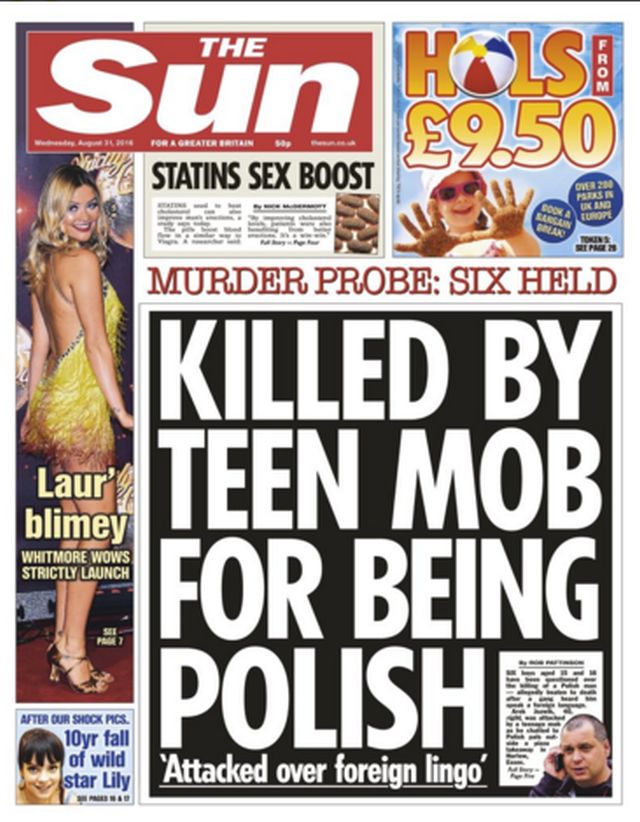
Image result for polish man killed in harlow front pages
70% of the UK national market is controlled by just three companies (News UK, Daily Mail and General Trust, and Trinity Mirror), with Rupert Murdoch’s News UK fully holding a third of the entire market share.
http://www.mediareform.org.uk/media-ownership/the-elephant-in-the-room

News Corp. controls 20% of the market share across all UK media outlets, almost twice that of the public service news services provided by the BBC.

Theories

Semiotics
Enigma codes and action codes difficult to take out of print text

Marxism and hegemony

 Marxist or Liberal pluralist approach would involve the media acting without outside influence from the government, it is also suggesting that the media to the best they can to give a fair and balanced approach to ongoing and past events.

The term hegemony refers to the dominance of social classes over other.  

Audience theories

 Blumler&Katz- people use newspapers for surveillance/information also for integration/social interaction as what people have seen in the newspaper is a topic for people to talk about though this isnt as common anymore when things like forums and comment sections exist online.

 Demographics, groups
for the newspapers in question it ranges from ABCDE-1234 and of all ages but readership is most heavily concentrated among older people 55+


Image result for pro brexit front pageTEXT 1 ANALYSIS
The sun a ‘swing’ paper owned by Rupert Murdoch is currently a right leaning paper in terms of the political spectrum. This front page released just before the EU referendum on the 23rd june 2016 conveyed the message of ‘pro-brexit’ and anti-EU encouraging the British people to vote leave in the referendum. The front page is very simple but has some conative meanings but some of the denotations include the only word in capital letters being ‘LEAVE’ which emphasises what the sun believe people should do during the referendum. Moreover, the play on words ‘BeLEAVE’ has an ambiguous meaning as it sounds like ‘believe’ but also suggests we should ‘leave’ the EU. They want people to believe that Britain can handle itself and that as a country we can leave the EU but also with ‘leave’ its almost as if they are commanding their readers to vote this way…most people reading the sun would most likely vote this way but this could solidify their choice and possibly influence others. Also, the Union Jack flag in the background of ‘LEAVE’ could evoke patriotism in some of the readers and help to convey the message of the leave campaign in a subtle way. Moreover, knowing the result of the referendum now this front page could be seen as an enigma code as the referendum question is not yet answered and this front page is suggesting that we as a country leave the EU.
https://blogger.googleusercontent.com/img/proxy/AVvXsEhuRq00oyp6DaQBx0kU70gCUQptgreKJib8tcr5yFP_nPqDNRoEIMIWvo3Wd4IktJTMgQ1-qtevVmCdp2IFPpugvu5vwCUG-JpjdqLCaFYPKQmckDX2M3GOS0kU1qWtTW1dn4SQ1SU3YED3qkdFx9mmVmBijRXFiuG9lKwmWbDFFH3grHMkqcOU3AjTqotAn4qqvMafuG7aps34bZFF3JKdZDxuWktomuRqFDYSHjJLFoE=s0-d
A group known as ‘Scott trust limited’ owns the guardian UK, the paper is left leaning on the political spectrum and was in support of the remain campaign. The Guardian have a more sophisticated audience that the sun and they tend to give their audience their information straight, reinforcing Blumler & Katz audience theory that audiences only use newspapers for surveillance and information and not entertainment. The photo used is very significant as it pretty much describes what the Guardians audience look like; white, middle class, sophisticated and a young audience. The glasses of wine also suggest the audience is more sophisticated and infers people who voted for remain are and those who voted to leave are less sophisticated as they would be out celebrating. A strong central image helps to bring the readers attention to the disappointment in their faces. Also the wording of the headline is ambiguous as it tell the reader that Britain is leaving the EU on paper but also suggests further isolation from Europe as we ‘set course for Brexit’ suggesting we are a vessel about to depart the eu into ‘international’ waters. The simple black, lower 

Thursday, 6 October 2016

Project proposal


Working title
'How significant were the tabloid newspapers pre and post EU referendum, in influencing peoples vote and opinion'

' How significant have british newspapers (front pages) been in influencing public opinion during the EU referendum campaign.

I will be looking at different newspaper front pages and analysing them to see how the techniques they have used may have influenced the public and how the institutions behind them control this. 

Angle
This investigation will explore the power of institutions and whether or not print is as influential as it once used to be. For instance the hate crimes stemming from the result of the EU referendum. Despite newspapers having to 'proof read' text before publishing why are so many misleading front pages published without consequence.

Hypothesis
The tabloid newspapers are still influential but not directly...content is always spread around online and on tv news where it gains more attention.

Linked production piece
Newsnight style documentary/ news report on the issue of the tabloid influence during and after the EU referendum. Film short segment outside parliament with interviews possibly.

MIGRAIN


  • What are the dominant images and iconography, and what is their relevance to the major themes of the text?
The dominant images featured on most front covers is the union jack and colours. this evokes patriotism in the readers especially those reading less intellectual newspapers such as 'The Sun'. Also, pictures of the queen are examples of iconography as this is relevant to themes including; Europe, UK, and patriotism.

  • To what extent are the audience’s generic expectations of the text fulfilled or cheated by the text? Does the text conform to the characteristics of the genre, or does it treat them playfully or ironically?
Expectations are generally fulfilled as the political opinion of newspapers dosent really change and their audience would typically stay the same. Although the sun is known to change its opinion from time to time but always produces the same material for its demographic groups.

  • In what ways has the text been influenced or shaped by the institution which produced it?
Newspapers in Britian are largely shaped by the institutions that own them, for instance the sun newspaper reflects the views of its owner 'Rupert Murdoch' as it is arguably a right wing paper. Also with the independent-Lebdev is further left wing and the paper reflects this. I dont believe a newspaper can be politically neutral...

  • What are the major values, ideologies and assumptions underpinning the text or naturalised within it?
This referendum revealed how(possibly) xenophobic the British public are as right wing newsapapers discusssed how they didnt want immigrants in the country and  to send the refugees somewhere else. 


  • How do you, as an audience member, read and evaluate the text? To what extent is your reading and evaluation influenced by your age, gender, background etc?
As a 17 year old student of mixed race background I believe that  the European union has and will continue to be a great thing, not having known anything esle. If given the opportunity to vote and having seen front pages from papers supporting brexit this would have made me want to vote remian even more as the audience category  that I would fall into read more intellectual papers with meaningful debates, however many people like me in this audience type are young and might not be able to vote.


SHEP

SOCIAL:
Newspaper readership loyalty...growing up with parents reading the sun influencing at younger age.

Influence that newspapers have on audiences of different ages.

HISTORICAL:
Comparing modern day newspaper front covers during and after the referendum to those during previous political votes .

1975 EC referendum

ECONOMIC
Vote Leave and Britain Stronger In Europe, to a spending total of £7m, while the spending limit for other registered campaigners (excluding political parties) has been set at £700,000.

Leave finances have come under intense scrutiny in the final days of the campaign after it was revealed that a former BNP member had donated £600,000.

Away from the campaigns, the total cost of conducting the referendum – which includes "the expenses incurred by counting officers in running the poll, the delivery by Royal Mail of campaign mailings and the cost of the central count" – has been estimated at £142.4m by the Cabinet Office.

POLITICAL
 (is a political debate)


Issues/Debates
Hate crimes stemming from result of EU referendum, the sun not making obvious link to brexit as a supporter of it.

Lack of censorship because of freedom of speech meant newspapers could lie on their front pages.
Image result for polish man killed in harlow front pages
70% of the UK national market is controlled by just three companies (News UK, Daily Mail and General Trust, and Trinity Mirror), with Rupert Murdoch’s News UK fully holding a third of the entire market share.

News Corp. controls 20% of the market share across all UK media outlets, almost twice that of the public service news services provided by the BBC.


http://www.mediareform.org.uk/media-ownership/the-elephant-in-the-room


Theories

Semiotics
Enigma codes and action codes difficult to take out of print text

Marxism and hegemony
 Marxist or Liberal pluralist approach would involve the media acting without outside influence from the government, it is also suggesting that the media to the best they can to give a fair and balanced approach to ongoing and past events.

The term hegemony refers to the dominance of social classes over other.  

Audience theories
 Blumler&Katz- people use newspapers for surveillance/information also for integration/social interaction as what people have seen in the newspaper is a topic for people to talk about though this isnt as common anymore when things like forums and comment sections exist online.

 Demographics, groups
for the newspapers in question it ranges from ABCDE-1234 and of all ages but readership is most heavily concentrated among older people 55+

Research plan (media texts, academic texts and websites)

Media texts 

The main texts i will be focusing on will be two left wing papers and two right wing papers, this will include 'The Guardian and the independent' and also 'The sun and the mail or the express' also data from the government website.

Other media texts
 itv news
good morning britain
other newspapers
youtube comments
online newspaper website comments

TV documentaries
New topic need to research if there are documentaries on the issue

Academic texts/books
 New topic, probably wont be any books on the issue but possibly some relating to it.

Internet Links

https://www.theguardian.com/media/greenslade/2015/feb/16/why-print-newspapers-remain-the-dominant-media-power-in-britain

https://www.theguardian.com/politics/2016/feb/26/a-largely-pro-brexit-press-could-be-significant-if-polls-are-close

https://www.theguardian.com/media/greenslade/2015/jun/08/newspaper-reader-election-ukip-express-sun-mail-telegraph

https://www.theguardian.com/media/greenslade/2016/jun/14/the-suns-brexit-call-is-unsurprising-but-it-has-symbolic-significance

https://www.theguardian.com/media/2016/sep/20/pro-brexit-articles-dominated-newspaper-referendum-coverage-study-shows

Wednesday, 28 September 2016

Ignite presentation learner response

Callum tabloid coverage of EU referendum.

-Excellent clear opening that outlines the topic, issues and background.

-Political background and press is described clearly-good communication and important context.

-Too much text on slides and presentation is increasingly reading this text to us. Very disappointing as the images selected are very good. Reading the text also means the presentation is rushed- hard to keep track of so much information.

-There clearly is very good research here but its too much to keep up with-as an audience it is
overwhelming.

-There are very interesting issues and debates that are suggested here- the final slide or two raises vital questions-but i'd rather have seen discussion and opinion of these during the presentation rather than reading off the slides.

- Presentation was so rushed it became difficult to judge whether staying focused on issue.

-Q&A- question on bias is good fit slightly difficult to follow, but really well handled with an excellent well thought out opinion. Knowledge of the political background impressive.

- Excellent Q on the influence of the internet on the debate...and the answer is thoughtful. q&a has been very impressive- should be more confident in own opinions+presentation skills for the main ignite part!

CONTENT-5
CLARITY-4
PRESENTATION -2
=11

WWW- I believe my research was done quite well and I had a lot of information and tried to incorporate this into my presentation. My presentations Q&A went well but should have had more of my own opinions in my presentations.

EBI- I could've condensed my information to make a better presentation with more rehearsal. Also i couldve expanded my research into something to compare the tabloids to.

From the presentation i am confident with sticking to the same question but changing it slightly to newspapers pre and post referendum as there would be more to talk about and compare making for an interesting critical investigation.

Sunday, 4 September 2016

Critical investigation

How much influence did the tabloid newspapers have on the recent EU referendum? 

http://www.thestudentroom.co.uk/showthread.php?t=1562617 -List of UK newspapers and where they are on the political spectrum. This is useful because it allows me to differentiate between the different types of papers and see if their headlines correlate with their political stance.

https://www.theguardian.com/media/2016/jul/01/rejected-remain-campaign-posters-revealed-by-ad-agencies
scrapped posters by the remain campaign, although not for the tabloids still interesting to see their approach.

https://www.themediabriefing.com/article/youth-audiences-newspaper-old-demographics-advertising
Age demographics of uk newspapers readers helpful to determine how influential the tabloids have been in swaying the referendum result.

http://www.bbc.co.uk/news/uk-politics-36616028
Different stats from eu referendum results including how different age groups voted...significant in comparison to which age group reads what newspapers.

http://www.bbc.co.uk/news/uk-politics-eu-referendum-36526778
How influential different media institutions have been, past and present in uk politics.

Centre to right wing papers


The Mail is known for being a more right-wing themed paper shwoing support for the brexit movement whilst also fuelling peoples patriotism by featuring the Queen and a giveaway related to that.


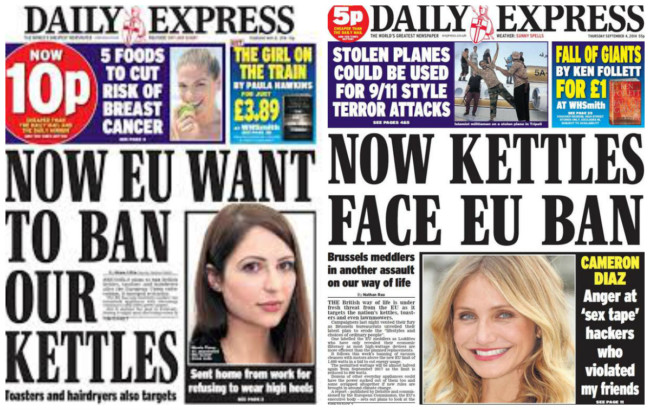
   Daily express known for supporting ukip and other right wing parties, using non-factual evidence that its audience will soak up.


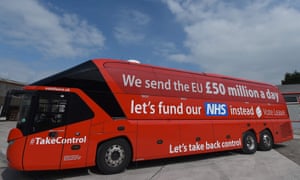
The "Vote Leave" battle-bus.Well known image of bus from leave campaign with evididence known to be false.


centre to left wing papers


Appealing to a more intellectual audience with better supported evidence but with a lot less followers than 'the sun' or other less intellectual right wing leaning papers.
                                       
A more intellectual paper gets into the 'politics' of the EU referendum debate rather than dumbing it down into little comments not backed up by any evidence like most of the right wing papers.
http://www.theguardian.com/politics/2015/jul/24/barack-obama-uk-eu-european-union-hostile-eurosceptic-reaction -A Guardian article on the backlash caused by US president Obama insisitng Britain should remain in the EU. This was a significant turning point in the debate as many people didnt like the fact a foreign president was getting involved in their politics which couldve been a reason more people voted leave instead of agreeing with obama and cameron who preeched remain.


MIGRAIN

Media representations
To this complicated argument there are two sides, 'Leave' or 'Remain' and these campaigns are largely being led by politicians including former London Mayor Boris johnson for leave and PM at the time David Cameron is seen to be the one driving the remain campaign. The subject being the EU referendum on Britians continued membership with it can be seen as unfairly represented in the tabloids as some papers such as the sun have a much larger following than some papers considered to be more intellectual that would better balance the argument and have justifications. Some of the less intellectual papers which lean more to the right on the political spectrum represent the eu referendum debate poorly and use it as an excuse to make a mockery of the EU and criticise elements of it which isnt always a bad thing, however instead of taking a more moral approach much of the leave campaigns evidence is flawed. Similar things can be said about the remain campaign, with both sides representing the argument unfairly with flawed evidence the public had a very difficult time in choosing a side but the popularity of the paper they read these 'facts' on had an influence on the result. However, the tabloids already acknowledge their sales have dropped significantly in recent years although many older people still purchase papers like the sun or daily mail which were strong supporters of the leave campaign. Moreover, the grey vote is very strong in politics as many young people dont understand the importance in voting. In terms of self representing there isnt really a neutral stance as a referendum is a simple question with a yes or no answer.


Media languages and forms
 The denotative meaning of this media debate is which way people voted on Britains continued membership with the EU and how this may have been influenced by the tabloids. Almost all of the tabloids front pages connote something for instance featuring different 'play on words' such as 'beleave in Britain' which itself is self explanatory and may not be seen as a connotation but also considering the abundance of red white and blue this could connote patriotism in some readers. The dominant images for the leave campaign include many pictures of the union jack or the red white and blue coloures that make it up are heavily used on the front pages. Whereas, the remain campaign have images of politicians and typically have bold titiles which can be seen as more sophisticated than
what the leave campaign were headlining. Although the different approaches are because of audience type. The reason for pictures of the union jack is to make the reader/electorate feel proud to be British and want to separate from the EU, this can also be seen when some centre to right wing papers have pictures of the monarchy which can make some readers feel more patriotic.

Narrative
Narrative is difficult to describe with the tabloids although it does develop the closer the referendum date gets and papers from both sides of the argument begin to give their opinions on the EU referendum. There are several characters the tabloids use in favour of their debate mainly politicians. For instance centre to right wing papers used Boris johnson, Michale Gove and Nigel farage on their front pages and portrayed them as heroes for trying to get Britain out of the EU but they also used David Cameron and other politicians from the remain campaign and portrayed them as the villains,


Genre
Non fiction/factual debate
The text does conform to the the characteristics of the genre as the centre to right wing papers use less sophisticated language to attract and convince their audience who tend to be less sophisticated. Whereas, the language used in the centre to left wing papers is more sophisticated and convinces a more sophisticated audience, however the more sophisticated audience is much less than the non sophisticated audience who read papers such as the sun. It is also worth mentioning age as older readers have the most significant vote compared to younger people and as centre to left wing papers had the most significant influence on the outcome it could be argued that older people were more convinced of the argument that the centre to right wing papers were giving.

Media institutions
The media institutions play an important role in determining the newspapers political stance and there is a clear pattern. For instance Rupert Murdochs 'News Corp' owns Uk papers 'the sun' and 'the mail' which are known as being centre to right wing papers which were in full support of Brexit and have a large audience.
Alexander Yevgenievich Lebedev- A Russian business man who is part owner of a vocal newspaper in Russia owns the centre to left wing paper in Britain 'The independent' which somewhat reflects his own views whilst not supporting a political party.

Media values and ideologies
Despite campaigning stopping for a day after the murder of MP Joe Cox the tabloids used this to their advantage and papers such as the I and the telegraph had headlines using joe coxs name and picture to sway her murder in favour of their opinion. This shows some of the institutions values as low and disrespectful. In recent years the more disrespectful a campaign is the more coverage it appears to get for instance donald trump in america and the leave campaigns comments from figures such a nigel farage.

Media Audiences 
Demographics and psychographics are included in the bbc article in the research section. The newspapers publish their most 'influential' headlines closer to the referendum date to try and have the most influence on their audience. However, the tabloids have seen a dramatic fall in their audience because of new technology however the older generation typically of 65+ continue to read the newspapers mainly the centre to right wing papers (find out newspaper stats) supporting the leave campaign which won and political votes are heavily influenced by the grey vote. Moreover, the uses and gratifications theory can be applied here with the majority of the audience using the headlines for surveillance.